
Chapter 1
The Boy from Saigon
My name is Hugh Nguyen. My Vietnamese name was Huy.
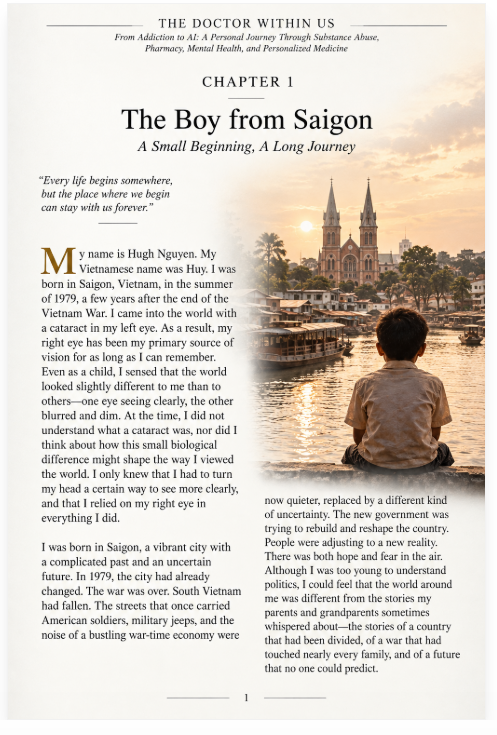
I was born in Saigon, Vietnam, in the summer of 1979, only a few years after the Vietnam War had ended. I entered the world with a cataract in my left eye. Because of it, my right eye became my primary source of vision, and it has remained that way throughout my life.
Of course, I understood none of this when I was born.
To me, the world simply looked the way the world looked.
I did not know that other people saw it differently.
Years later, I would spend a great deal of time thinking about biology—about genes, medications, the brain, and why one human body can respond so differently from another. But my first lesson in biological difference came before I could even speak.
It was written into my own body.
I had one good eye and one eye that could not see the world clearly.
Perhaps there is something fitting about that now.
Much of my life would eventually become a search for another way of seeing.
My Mother
My mother came from Bình Định Province on the central coast of Vietnam.
Bình Định is a place with a long history and a proud cultural identity. It is also famous for its tradition of martial arts. My mother, however, fought her battles with books.
She was an excellent student, particularly in mathematics and biology.
Her parents were farmers, and opportunities for young people in rural Vietnam were limited. Education offered another path.
To continue her education, however, she first had to pass the difficult high school exit examination known as the Tú Tài. Passing such an examination could change the direction of a young person’s life.
My mother studied hard.
I sometimes wonder what she imagined during those years. Perhaps she pictured Saigon, a city far larger and more sophisticated than the community in which she had grown up. Perhaps she imagined a profession, financial independence, and a life beyond the boundaries of rural Bình Định.
Whatever motivated her, she succeeded.
She eventually came to Saigon and became a nurse.
Many years later, I would enter healthcare myself and study pharmacy. I would learn biology, chemistry, pharmacology, and the mechanisms through which medications affect the human body.
But science had entered my family before it entered my life.
It came through my mother.
She understood biology long before I did.
My Father
My father came from Tân An, the largest town in Long An Province in southern Vietnam.
Like my mother, he was an excellent student.
He passed his high school exit examination with honors. He came from a devout Catholic family and, from the stories I heard, had once been a shy and studious young man.
Had history unfolded differently, perhaps his life would have followed an entirely different path.
But history rarely asks permission before entering a family.
Vietnam was at war.
My father eventually became an officer in the Army of the Republic of Vietnam, commonly known as the ARVN—the military of South Vietnam.
The shy student from Tân An became a soldier.
And the soldier went to war.
I never knew the young man who existed before that transformation. By the time I was old enough to remember my father, the war was already part of his past.
But a war can end on a map long before it ends inside a person.
During his military years, my father began drinking heavily.
He became an alcoholic.
As a child, that was essentially all I understood.
My father drank.
I did not know about psychological trauma. I did not understand addiction. I had never heard words such as neurotransmitter, dopamine, GABA, dependence, or post-traumatic stress.
I certainly did not understand how a chemical substance could enter the brain and temporarily change the way a person experienced fear, sadness, anxiety, or emotional pain.
I simply knew what I could see.
Sometimes my father was sober.
Sometimes he was drunk.
And somehow the liquid inside a bottle could turn one version of my father into another.
That mystery stayed with me much longer than I realized.
The Silent Aunt
There was another mystery in my father’s family.
His youngest sister—my youngest aunt—rarely spoke.
I remember meeting her as a child and noticing that she was different from the other adults around me. Conversations happened around her, but she seldom participated in them.
At the time, I had no explanation for it.
Children generally do not construct neurological theories about their relatives. They observe. They remember. Only much later do they try to make sense of what they saw.
Decades afterward, when I studied pharmacy and psychopharmacology, I began thinking about my aunt again.
I wondered whether there might have been some neurodevelopmental explanation for her behavior. And once I began asking that question, another inevitably followed:
Could there have been biological or genetic characteristics in my father’s family that had also been passed down to me?
I cannot diagnose my aunt retrospectively, nor can I know from childhood memories alone why she rarely spoke. There are many possible explanations.
But the question itself became important.
It was one of the first times I began looking backward through my family’s history using the scientific knowledge I had acquired as an adult.
The family stories had not changed.
I had changed.
I now possessed a different vocabulary with which to examine them.
Genetics.
Neurodevelopment.
Psychiatry.
Pharmacology.
Environment.
Trauma.
Addiction.
What once appeared to be unrelated characteristics scattered across generations began to raise a larger question for me:
How much of who we are comes from the lives we experience, and how much comes from the biology we inherit?
I would spend much of my adult life circling that question.
The Nurse and the Soldier
My parents’ paths eventually crossed at one of Saigon’s great hospitals.
My father had suffered a recurring wound related to his military service and went to Chợ Rẫy Hospital for treatment.
My mother was one of the nurses who cared for him.
It is strange to think about how much of a person’s existence can depend on an ordinary event.
A patient enters a hospital.
A nurse is assigned to care for him.
They speak.
They get to know each other.
And eventually two people who might otherwise have remained strangers create an entirely new family.
Without that hospital encounter, there would be no story for me to tell.
My mother was twenty-eight years old at the time. In Vietnamese society then, a woman of twenty-eight could already be considered relatively late to marriage.
There was another complication.
My mother had been born in the Year of the Tiger.
According to an old Vietnamese superstition, women born under the tiger zodiac sign could be considered too strong-willed, too independent, or too difficult for a husband to control.
My mother was also from Bình Định, a province associated with martial arts and strong women.
The combination apparently intimidated some potential suitors.
My father was not intimidated.
Perhaps after surviving a war, a woman born in the Year of the Tiger did not seem particularly frightening.
He pursued her.
By then, however, his circumstances were far from ideal.
The South Vietnamese government he had served no longer existed. His side had lost the war. Like many former South Vietnamese military personnel, he had been sent to a reeducation camp after the Communist victory.
When he was released, he returned to a country that had been transformed.
He was a former officer of the defeated army.
He was unemployed.
His future was uncertain.
And yet he wanted to marry my mother.
In the fall of 1978, with the blessings of both families, they were married.
Less than a year later, I was born.
The House in the Alley
After their marriage, my mother received a tiny apartment through Chợ Rẫy Hospital in District 5, an area of Saigon closely associated with the city’s Chinese-Vietnamese community.
The apartment was sufficient for two newlyweds.
It was not sufficient for the family my grandparents expected them to have.
My maternal grandparents were farmers from Bình Định, but they understood something fundamental about family life: children require space.
So they began looking for a house.
Saigon was filled with narrow homes built upward rather than outward. Land was precious, and many houses resembled vertical rectangles squeezed between their neighbors.
Eventually, my grandparents discovered something different.
It was a relatively spacious house tucked away inside an alley.
To them, it felt more familiar—more like the kinds of homes they knew from rural Vietnam.
They bought it.
Looking back, it turned out to be one of the best investments they ever made.
And shortly afterward, that house became my home.
I was born in the summer of 1979.
A little more than a year later, my younger brother, David, was born.
There were now four of us.
My mother worked.
My father stayed home.
The former soldier became the person who took care of two little boys while his wife supported the family.
From a modern perspective, there is nothing remarkable about a father staying home with his children.
But circumstances matter.
My father had not freely chosen early retirement or decided that being a stay-at-home parent was his preferred lifestyle. His country had disappeared. The military career that once gave him status and purpose had disappeared with it. Under the new Communist government, employment opportunities for a former South Vietnamese officer were limited.
He had survived the war.
Now he had to survive the peace.
And sometimes peace creates its own casualties.
The Bottle
Throughout the 1980s, my father continued drinking.
For many years I thought of his alcoholism primarily in moral terms.
Why couldn’t he stop?
Why would someone continue doing something that caused so much trouble?
Later, pharmacy changed the way I thought about those questions.
I began learning what substances actually do inside the human brain.
Alcohol is not merely a bad habit contained inside a bottle. It is a psychoactive drug. It alters neural signaling. It changes inhibition, judgment, anxiety, mood, memory, and behavior. Repeated exposure can produce tolerance and dependence. The brain itself adapts.
That scientific understanding did not erase the consequences of my father’s drinking.
But it complicated the story.
I began wondering what alcohol had done for him before asking what alcohol had done to him.
Perhaps, temporarily, it quieted something.
The memories of war.
The humiliation of defeat.
The experience of imprisonment.
The frustration of unemployment.
The loss of status.
The responsibility of raising children while feeling that the world he had prepared himself for no longer existed.
I will never know exactly what happened inside my father’s mind.
But I began to understand something important:
People sometimes use substances not because those substances make their lives better, but because for a few hours they make their pain feel farther away.
In that sense, I sometimes think of alcohol as my father’s self-prescribed “antidepressant.”
It was certainly not an antidepressant in the medical sense, and chronic alcohol use can worsen depression and create enormous medical and psychological harm.
But perhaps he was seeking something that psychiatric medications are also intended, in a very different and medically supervised way, to provide:
relief from suffering.
That thought would become deeply significant to me decades later.
Because eventually I would need relief myself.
When the Pharmacist Became the Patient
I could not have imagined it as a boy sitting inside that house in Saigon.
I could not have imagined pharmacy school.
I could not have imagined studying receptors, enzymes, neurotransmitters, pharmacokinetics, or psychopharmacology.
I could not have imagined depression.
I could not have imagined obsessive-compulsive disorder.
And I certainly could not have imagined taking medications intended to alter the chemistry of my own brain.
Yet eventually I would.
And something happened that surprised me.
The medications did not always work.
Some medications that helped other people did little for me. Finding an effective treatment could mean waiting weeks, adjusting doses, dealing with adverse effects, changing medications, and starting again.
The pharmacist had become the patient.
And suddenly the questions were no longer academic.
Why does one drug work for one person but fail another?
Why does one person experience severe adverse effects while another tolerates the same medication easily?
Why can two patients receive the same diagnosis, take the same dose of the same medication, and have completely different outcomes?
And most importantly:
Why can’t we predict these differences before giving someone the medication?
Medicine has become extraordinarily sophisticated.
We can sequence the human genome.
We can measure concentrations of drugs in the bloodstream.
We can identify genetic variations in enzymes that metabolize medications.
We can collect enormous amounts of health information through electronic medical records, laboratories, pharmacies, smartphones, and wearable devices.
And now we have artificial intelligence capable of discovering patterns across quantities of data that no human being could analyze alone.
Yet much of medicine—particularly psychiatric medicine—still contains an uncomfortable amount of trial and error.
Try this medication.
Wait.
See what happens.
If it fails, try another.
For someone suffering from depression, those weeks are not abstract units of time.
They are weeks of a human life.
That realization eventually led me to the idea at the heart of this book.
What If Medicine Could Learn From All of Us?
Imagine that millions of patients voluntarily contributed their treatment experiences to a secure health-data network.
Not merely which medications they took, but what happened afterward.
Did the medication work?
How long did it take?
What dose was required?
What adverse effects occurred?
Why was it discontinued?
What other medications was the person taking?
What medical conditions did the person have?
And, for people who voluntarily chose to contribute it, what did their genomic information reveal?
One person’s experience is a story.
A million experiences become a dataset.
And a sufficiently rich dataset can reveal patterns.
Artificial intelligence might someday allow us to detect those patterns at a scale that was previously impossible.
The question could gradually change from:
“Which antidepressant usually works?”
to:
“Which antidepressant is most likely to work for this particular person?”
That distinction represents the difference between population medicine and personalized medicine.
It does not mean that AI will replace physicians.
It does not mean genetics can perfectly predict treatment.
And it certainly does not mean that medicine will ever eliminate uncertainty.
Human beings are too complicated for that.
But perhaps we can reduce the uncertainty.
Perhaps we can reduce some of the trial and error.
Perhaps the experiences of yesterday’s patients can help tomorrow’s patients avoid treatments that are unlikely to help them.
That is the idea I want to explore in this book.
But for me, the idea did not begin with artificial intelligence.
It did not begin with genomics.
It did not begin with a computer.
It began many years earlier, in a house hidden inside an alley in Saigon.
It began with a nurse from Bình Định.
A former soldier from Tân An.
A silent aunt.
A bottle of alcohol.
And a little boy with one good eye who did not yet understand why the people around him behaved the way they did.
I would spend much of my life trying to understand them.
Eventually, I realized that I was also trying to understand myself.
And somewhere along the way, one question became another.
What if the doctor of the future does not exist only in the hospital or the clinic?
What if part of that doctor exists within the accumulated biological information and lived experience of every patient who came before us?
What if, by learning from one another, we could finally make medicine more personal?
Perhaps the doctor we have been searching for has been within us all along.